
TRUST IS THE PRECURSOR TO SUCCESS IN BUSINESS RELATIONSHIPS. HERE’S HOW TO BOOST CUSTOMER TRUST IN YOU.
Finding and acquiring new customers is the lifeblood of any SEO or digital marketing firm. But before any prospective customer will agree to work with you, they need to trust in you.
After all, you’re asking for a lot: you want them to write you a hefty check and – if you deliver ongoing services – possibly commit to a long-term relationship. Even if your sales and marketing processes are top-notch, no one is going to sign up to work with you unless they have confidence that you’ll be able to make good on your promises.
The process of cultivating trust begins with a layer of twin customer concerns.
First, they need to trust that you know what you’re talking about. In other words, do you genuinely have the technical expertise in working with search engines and the digital marketplace?
Second, they need to trust that you can deliver successful business outcomes. You’ve probably made promises that have left them hopeful and optimistic, but how do they know if you can actually achieve the results they want or need to see?
In this paper, we’re going to focus on deploying “trust factors” to showcase your own trustworthiness and cultivate customer confidence in you. These are the kinds of signals that customers look for when evaluating a potential SEO or digital marketing partner.
Then, we’ll look at some strategies for how to get others to help as well, through various forms of “social” proof. Finally, we’ll discuss a few techniques that might help risk-averse customers take the plunge.
Ultimately, it’s all about getting that hesitant or doubtful customers to feel comfortable signing on the dotted line.
Let’s get started.
In This Paper...
- Prove your expertise
- Prove your achievements
- Let others prove your trustworthiness for you
- Make it easier for customers to trust you
First, Prove Your Expertise
Do you actually know what you’re doing? Before anything else, your firm needs to prove to prospective customers that you are, in fact, experts in the services you deliver, be it search engine optimization, pay-per-click advertising, or other forms of digital marketing. These are activities that require an in-depth understanding of frequently shifting technical masteries (like Google’s complex and ever-changing search ranking algorithm). Expertise is required.
One of the best ways to communicate your bona fides is through smart use of content. According to DemandGen, fully 95% of B2B buyers consider content to be trustworthy when assessing a business and its services.1In other words, content breeds credibility. Good content is also an excellent way to differentiate your business from your competitors. The SEO industry is intensively competitive, but it also includes a lot of fly-by-night organizations that only know enough to be dangerous. Content that showcases your knowledgeability can help your firm stand apart as true experts.
- WEB CONTENT
The path to trustworthiness starts on your website. Your web content needs to be authoritative, expert, and ideally specific rather than generic. You don’t want to get lost in the weeds or to overwhelm the customer, but every page of your website should explicitly and subliminally communicate that you know what you’re talking about. - BLOG CONTENT
Blogs are the standard vehicle for showcasing knowledgeability. They’re also very flexible; whether short or in-depth, every blog offers an opportunity for you to showcase some element of your expertise. Simultaneously, as you likely already know, every blog creates a new doorway into your website for Google to index and rank. - TECHNICAL AND WHITE PAPERS.
Papers are a must when showcasing expertise; they are by far the most influential form of content for enterprise buyers of technical services in particular (see the chart below). The key is to make sure that the papers are genuinely useful. You’re not just saying “look at our amazing expertise” with this content, you’re proving that you can genuinely help your customer.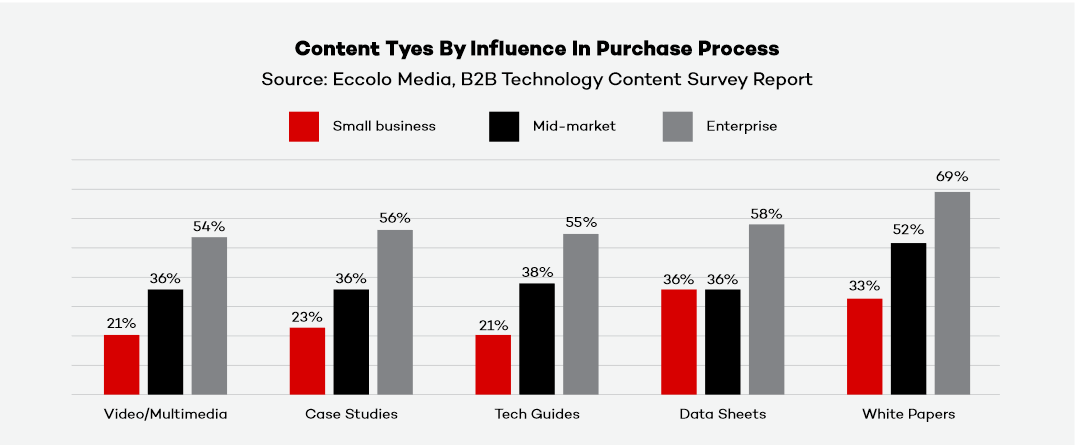
- Video and Webinars
Like papers, video and online, interactive content like webinars give you a chance to demonstrate expertise through a medium that offers greater immediacy and interactivity. Again, the focus should fall on solving customer problems. This is the most likely approach to attract customers to attend the webinar, and it’s the most likely approach to convince them that you know you’re talking about. - Published Articles
Published articles are no more difficult to produce than blog content or papers, but through the process of getting them published on reputable third-party websites and online magazines, they gain the veneer of third-party approval. The content itself exposes your expertise, while the act of publication subliminally says, “Others recognize our expertise too.” - Product Data Sheets
Product collateral and data sheets are also critical. This is foundational stuff: your services must add up. If you’re promising particular benefits, the specifics around what you offer must be able to support those outcomes. Customers look at marketing collateral, product brochures, data sheets, and similar documents to assure themselves that your services match up with your promises
Next, Prove Your Achievements
Once you’ve proven that you know what you’re talking about, the next step is to prove that you are capable of applying that knowledge to effectively generate successful outcomes. Think of it this way: if the content we discussed in the previous section serves as a portfolio of expertise, now we want to establish a portfolio of achievement. But how do you do this?
Case studies
Bar none, case studies are the prime example of proof that you can achieve the kind of results that you claim. That’s because they allow potential customers to see what you’ve done for actual existing customers.
Case studies also one of the most popular forms of lead generation in the U.S., with nearly two-thirds (62.6%) of marketers saying that case studies are effective in generating leads.2 As the chart above indicates, they’re also among the effective forms of content in influencing purchasing decisions.
One word of warning: always keep your eyes on the prize when developing case studies. It can be easy to be overly technical or veer away from the core issue in a case study. At heart, you solve the customer’s problem or pain point. But how? The case study needs answer that question head on.
|
Other proofs of achievement |
||
|
Clients |
Awards |
Milestones |
|
Not all clients will agree to, or be suitable for, a case study. Thankfully, even just listing a client, particularly a prominent one, can be effective in proving your firm to prospective clients. In fact, incorporating client logos on your website can potentially boost conversions by up to 400%.3 A client list may not showcase specific results, but it can definitely prove that you’ve been successful enough to garner an impressive array of customers. |
Most industries have a selection of awards that can prove you are effective in your work. In the SEO industry, these awards are numerous and include the Search Engine Land Awards, the U.S. Search Awards, and TopSEOs.com’s own Top 10 rankings. Winning awards and top ranks is not necessarily as daunting as it may sound. Often, the real work is in the application process and making you’re your story stands out from the crowd. Ultimately, the words “award-winning” are also “trust-boosting.” |
Have you served a notable number of customers or seen an impressive number of users? Been in business for X number of years? The idea behind sharing milestones is that only successful companies achieve milestones at all. Reaching one or more important business milestones is by itself a trust- strengthening achievement. One key: consider your primary competitors in the marketplace. If your milestones are noticeably inferior to theirs, highlighting milestones may be unhelpful or counterproductive. Focus on the milestones that differentiate you. |
Let others prove your trustworthiness
Your organization doesn’t need to shoulder the entire burden of boosting your own trustworthiness. One of the most effective ways to prove your credibility is to let others do the proving for you. Almost any statement you make on your own behalf will be met with some degree of skepticism by savvy (or cynical) clients. It’s much more convincing when the comments, examples, and proofs come from third-party sources.
Customer reviews
At the top of this list are customer reviews. People today pay very close attention to reviews. Moreover, they trust them: 88% of consumers, in fact, trust user reviews as much as personal recommendations!4
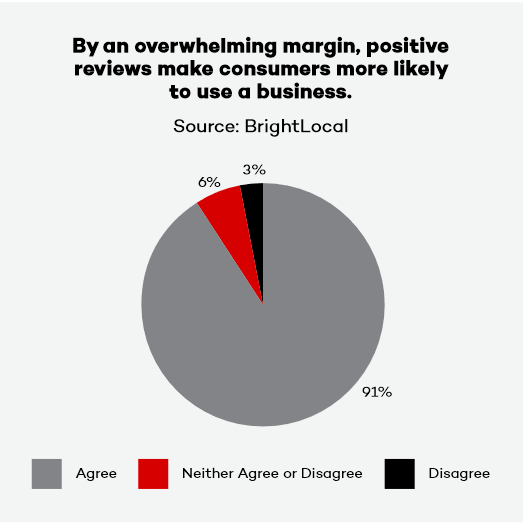
Reviews act as one of the most potent forms of social proof available. Third-party reviews are particularly effective, and the content and star rating of those reviews – whether they’re positive or negative – can have a determinative effect on whether a prospective customer chooses to be do business with you or not (see the pie chart.)5
Pro tip: actively manage your reviews. If you leave them to chance, you’re more likely to aggregate negative reviews because frustrated or irritated customers are more likely to take the time and effort to leave comments. Conscientiously request reviews from happy and satisfied customers; most of them will be happy to leave a review upon request.
Also, make sure your review listing shows up in the right categories for which your target customers will be looking for you, e.g., not just “Best SEO reviews” but also the more targeted categories like “Best link-building companies” or “Best YouTube marketing companies” – whatever prospective customers will search out.
Testimonials
Closely related to reviews, testimonials reflect distilled positive impressions of your company from existing or previous customers. They are, in general, considered very trustworthy: 92% of consumers are more likely to trust non-paid recommendations than any other type of advertising.6 That may be why testimonials are able to increase conversions on sales pages by 34%.7 If you’re not sure where to turn for testimonials, look at customer feedback (including informal feedback, like complimentary comments in emails) and reviews that you get from customers.
Other forms of user generated content
Because reviews come from users rather than from the business, they’re called user-generated content (UGC). But there’s more than one form of UGC. Social media posts that discuss or mention your brand are another, as are online links to and citations of your business or web content. Almost any time your business is mentioned through UGC, it credentials your reputation and trustworthiness.
Endorsements & brand ambassadors
Closely related to testimonials are endorsements. They are slightly different, though. With endorsements, your firm leans on someone else's trustworthiness. If you can get known, credible, and trusted voices to endorse your services or your firm, your prospective customers are more likely to believe and trust that you can achieve desirable outcomes for them. This is sometimes referred to as "influencer marketing," and it can be very powerful. Endorsements represent a type of social proof sometimes referred to as the "Expert's Stamp of Approval.
Certifications
Another form of the expert's stamp of approval is independent, third-party certification. There are many options for certification in the SEO world8, but be aware that Google itself does not offer any SEO certification programs. Still, a standalone, third-party certification program or course enables your firm and its employees to show that a third-party authority has recognized your expertise or abilities. That's another form of proof that you know you're talking about and can execute effectively in this industry.
Make it easier to trust you
A fourth form of proving trustworthiness is worth mentioning, though these tactics are different from the previous sections. They’re less about proving yourself per se and more about giving risk-averse customers more confidence to do business with you.
Guarantees, for example, will reduce risk in the customer’s mind. In fact, money-back guarantees have even been shown to increase customer feelings of satisfaction.9
You might guarantee a certain degree of responsiveness; for example, you might promise to respond to questions or issues within a certain number of hours. You might even guarantee results if you’re confident that you can deliver them. If the customer knows that they’re will get money back or some other compensation if they don’t get a promised outcome, they may be more willing to take the risk in the first place.
You might wonder if guarantees will end up costing you so much that they eat into or erase profits. In general, that doesn’t appear to be the case; most retailers, at least, appear to remain profitable with certain types of guarantees.10 Still, it is worth doing a cost-benefit analysis of any guarantee you offer.
Similarly, incentives and special offers can also make it easier to trust you. They give the customer a reward for choosing to do business with you, so that even if the relationship doesn’t work out ideally, they’ll still have gotten something out of it.
In conclusion
Fostering customer trust in your business is key to ongoing success. It helps to generate more interest in your services, and it helps to turn more leads into paying customers. Trust is also something that’s straightforward (though not necessarily easy) to foster. Through a specific series of strategies and tactics, your SEO firm can prove that you know what you’re doing, that you’re capable of fulfilling your promises, and that doing business with you is a good idea. All you need to do now is get started.
References
1 https://www.demandgenreport.com/resources/research/2016-content-preferences-survey-b2b-buyers-value-content-that-offers-data-and-analysis
2 https://neilpatel.com/blog/why-you-need-to-create-case-studies-and-how-to-generate-leads-from-them/
3 https://conversion-rate-experts.com/voices-case-study/
4 https://blog.hubspot.com/marketing/social-proof-examples
5 https://www.brightlocal.com/research/local-consumer-review-survey/
6 http://www.nielsen.com/us/en/insights/news/2012/consumer-trust-in-online-social-and-mobile-advertising-grows.html via https://optinmonster.com/social-proof-statistics/
7 https://www.impactbnd.com/blog/whats-changed-with-social-proof-in-2019
8 https://www.reliablesoft.net/seo-certifications-guide/
9 http://psycnet.apa.org/record/1987-12227-001 10http://onlinelibrary.wiley.com/doi/10.1111/j.1937-5956.2012.01394.x/full


